Thursday, 15 August 2013

Here are the campaign issues in Norway

NEWS ANALYSIS: As Norway’s parliamentary election campaign clicks into high gear, much of the local media attention has been on how the parties stand in the polls and how they might cooperate to form a government. That’s overshadowed many of the actual issues at stake, so it’s time, perhaps, to offer a rundown of how a new non-socialist government would differ from the current left-center coalition.
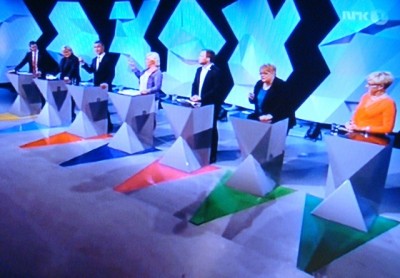
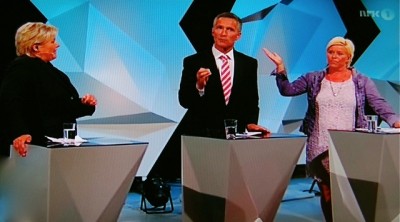
No, it's not a large Kraftverk concert, rather all the leaders of Norway's seven largest political parties gathered for their first major debate of the election campaign on Monday night. Their constant maneuvering for government power has all but clouded the actual issues at hand, and voters can't be sure which parties will eventually form a government. PHOTO: newsinenglish.no/NRK screen grab
No, it’s not a large Kraftverk concert, rather all the leaders of Norway’s seven largest political parties gathered for their first major debate of the election campaign on Monday night. Their constant maneuvering for government power has all but clouded the actual issues at hand, and voters can’t be sure which parties will eventually form a government. PHOTO: newsinenglish.no/NRK screen grab
Many questions remain, not least because the four non-socialist parties have refused to campaign on a common platform. No one can say what kind of government they may form if they jointly win, as expected, a majority of seats in Parliament. Instead of taking firm stands or revealing how they may cooperate, they’ve been keen to campaign separately and stress the differences among themselves, even though it’s unlikely any single party will win enough votes to rule alone.
Norway’s two biggest parties, the Conservatives and Labour, appear most likely to lead any coalition. Siv Jensen, leader of the country’s third-largest and most conservative Progress Party, made an interesting and provocative comment earlier this week when she claimed it was difficult to see major political differences between the two arch-rivals. She accused Conservatives leader Erna Solberg of “living in a social democratic bubble” and running a campaign that tried to further similarities among the parties instead of differences.
“The whole point of changing a government must be to change politics,” said Jensen, repeating much of the same at Monday night’s debate and stressing the need for voters to vote for the party that best reflects their own politics. Jensen’s comments can hardly grease the skids for a much-vaunted cooperation between her party and Solberg’s.
Voters are left with only a general idea of how things might work if either the left or the right emerges victorious. Here are some of the main issues in the country that’s already widely dubbed to be the best place on the planet to live:
Price levels

Jensen claims that without her party in a non-socialist government, there won’t be any real change in Norway’s notoriously high prices for food, drink and most other household items. The Progress Party wants to seriously cut subsidies to farmers, reduce Norway’s protectionist tariffs that keep out imports, and cut taxes on alcohol and other consumer goods. The Conservatives go along with some of that but Solberg has cautioned that any major cuts would come as too great a “shock” to producers.
In the current left-center government, Labour went along with the Center Party’s demands for more protectionism and more support for farmers, which led to the controversial new tariffs on imported cheese and meat and sent prices up again at the grocery store. A non-socialist government is expected to reverse them.
Oil revenue use

Jensen has long campaigned for more use of Norway’s oil revenues, instead of stashing the vast majority of them away in a fund for future generations. Solberg also wants to spend more, but not as much as Jensen, and the Conservatives and the two other non-socialist parties, the Christian Democrats and the Liberals, want to abide by the rule limiting spending to 4 percent of the size of the fund.
The Labour-led coalition won’t spend any more than the 4 percent limit, and has spent less.
‘Pappa permission’

This turned into a bigger campaign issue than expected as the parties argued over how families should be able to use the 59 weeks of fully paid parental leave they get upon the birth of a child.
On this issue, the non-socialists are arguing among themselves, with the Conservatives and Progress Party keen to remove a requirement that at least 14 weeks must be used by fathers. Their potential partners, the Christian Democrats and the Liberals, want to keep the “pappa quota,” as do all three left-center parties: Labour, the Center Party and the Socialist Left.
Worklife

Here the non-socialists want more flexibility over how working time should be determined, and they want to ease other restrictions on employers as well. The incumbent government parties want to maintain all current restrictions and actively fight against social dumping and exploitation of foreign labour.
Hospitals and health care

The Labour-led parties want to maintain a strong public health care system and full state control over hospitals. They don’t want to turn hospital care over to the private sector.
The non-socialist parties want to allow more private players into the health care system and they want the state to send more patients stuck on waiting lists over to private clinics. The Conservatives recently raised eyebrows by revealing that they may increase the relatively small portion of health care costs that are paid by patients (called egenandel), with Labour officials claiming that’s not much different than a tax increase. The Conservatives also have been accused of not clarifying how they would pay for health care improvements, since they also favour tax cuts.
Defense

Not a big issue in the current campaign, with the pullout from Afghanistan underway and Norwegian defense policy so closely connected to NATO’s. The military also has been undergoing major reorganization and modernization moves, and women can now be called in for service, so many issues that were hotter a few years ago have been resolved. Debate continues over the huge expense tied to orders for new fighter jets from the US.
Media support

The Labour-led government wants to maintain current levels of financial support for various media outlets, claiming it ensures a diversified, nationwide media. Without the financial support, several newspapers face closure.
The Conservatives want to cut media subsidies by NOK 100 million, the Progress Party wants to cut it by NOK 180 million and their partners want to either limit or continue it. A Conservative-led government would most likely cut media subsidies by some negotiated degree.
Taxes

The current left-center government wants to maintain current tax levels. The Conservatives want tax cuts of around NOK 25 billion, the Progress Party advocates cuts of NOK 100 billion and their partners much less or none at all. A non-socialist government would probably reduce overall tax levels, not least on the controversial fortune tax on individual net worth.
Oil drilling off Lofoten

Two of the three government parties formally oppose it, even though Oil Minister Ola Borten Moe from the small Center Party supports it. Labour wants to move forward with a feasibility study of it, because of the jobs it would create.
Both the Conservatives and the Progress Party also want to move forward with oil drilling off Lofoten, while their two partners are firmly opposed. On this issue, the dynamics in both blocs are largely the same, but the small parties may prevail.
Foreign aid

The Socialist Left wants to further increase Norway’s already substantial levels of foreign aid, while the two other socialist parties want to maintain current levels. The non-socialists want to either reduce foreign aid or redefine how it’s extended. Reductions would be likely if they win government power.
Immigration and asylum

The current government wants to continue existing policies. This issue is particularly divisive on the non-socialist side, with the Progress Party demanding restrictions and the two smaller parties wanting more liberal immigration and asylum laws. The Conservatives are caught in the middle and would likely force through a compromise.
Foreign policy

Norway’s political parties generally come together on foreign policy issues and most foreign policy is likely to continue regardless of a change in government. There is potential for some change, though:
The Conservatives have always been in favour of joining the European Union (EU) and now may wind up with a majority of like-minded colleagues in parliament. The Progress Party has kept mum on the EU issue while Labour also is believed to support EU membership, but has been held back for the sake of government unity, since its two left-center partners firmly oppose joining the EU.
Changes may thus come on the EU issue, as well as in the areas of foreign aid (see above) and on human rights issues. It was a Conservative politician (Jan Tore Sanner) who nominated Chinese dissident Liu Xiaobo for the Nobel Peace Prize, which plunged Norway into diplomatic crisis with China. Now Conservative politicians also advocate a tougher stance against Russia on human rights issues.
The Conservatives also are likely to move away from Labour’s eagerness to engage in peace talks around the world. Ine Marie Eriksen Søreide, a candidate to be foreign minister for the Conservatives, told newspaper Dagsavisen this summer that she wants to dampen Norway’s image as a “peace nation” so as not to spread Norway’s resources too thinly. She also wants to restrict peace brokering to areas that would clearly serve Norway’s interests.
Schools

The current left-center government claims to put a priority on a strong public school system. They are traditionally skeptical towards private schools, and want to maintain a system where elementary school students don’t receive grades on the work they do.
The non-socialist parties want to allow more private schools and start grading students from the 5th grade. The Liberals and Christian Democrats side with the socialists on these issues.
Road financing

The socialist parties want to maintain Norway’s current combination of road tolls and state funding. The Progress Party is the only party that wants to do away with tolls. The Conservatives and Liberals want more cooperation between the public and private sectors on road financing.

Wednesday, 14 August 2013

Press release: Ginbot 7 Popular Force fundraising task-force in Norway

August 14, 2013

Ethiopia and its citizens have never been endangered and humiliated as under the rule of the woyane junta. The current problem of the country and its people is not only a question of lack of basic human rights, but it is a matter of life and death to the people and existence of Ethiopia as a sovereign country.
Ginbot 7 Popular Force fundraising
To fight the enemy which is responsible for the aforementioned situation and avert the danger, Ethiopians are wedging armed struggle and this is increasingly becoming the only and appropriate alternative.
Hence, Ginbot 7 Popular Force (G7PF) is established by freedom-loving Ethiopians, comprising youngsters, intellectuals and others. The main objectives of this force, as described on its website, are contributing to make the Ethiopian people owner of political power and establishing strong, sovereign and democratic Ethiopia. G7PF is working to remove TPLF by force and to create a peaceful transition period enabling establishment of non-partisan and constitutional defense, police, security, judiciary, etc. institutions which are crucial for a healthy playground for different political parties aspiring power in the country.
Among the current G7PF members are many intellectuals who joined this force abandoning their relatively comfortable living, families and professional jobs. This is one of the advantages of the G7PF compared to traditional armed struggles in Ethiopia where mainly farmers and other non-intellectuals are the main components of foot soldiers. Thus, the struggle of Ginbot 7 Popular Force gets skillful leadership on the ground and its members at the front properly understand why and whom they are fighting for and paying sacrifices.
Appreciating the efforts and the good intentions of G7PF, we Ethiopians in Norway have decided to support the force and established ad hoc committee (taskforce) mandated to coordinate a one-time fundraising in Oslo. As from the date of its establishment the taskforce is working on various activities and scheduled 28th of September, 2013 the date for the grand fundraising event in Oslo.
During this event, on 28 of Sep., 2013, representatives of the G7PF leadership will be present and the program of the event comprises, discussions, fundraising and entertaining activities.
Therefore, the taskforce herewith kindly invite all Ethiopians and other nationals both from Norway and neighboring countries to take part in this event and support G7PF.
Freedom, justice and democracy to all Ethiopians!
Ethiopia shall prevail!
Ginbot 7 Popular Force fundraising coordinating ad hoc committee in Norway
August 14, 2013, Norway, Oslo

UNHCR remains concerned by high numbers of refugees and migrants arriving in Yemen

UNHCR remains concerned by high numbers of refugees and migrants arriving in Yemen
unhcr
In Yemen, UNHCR has so far recorded the arrival of more than 46,000 refugees and migrants during the first six months of 2013, and we remain concerned about the increasingly high numbers of people making the dangerous trip by boat from the Horn of Africa
The number of asylum seekers, refugees and migrants in Yemen has been rising for the past six years. Last year, a record 107,500 people made the journey. And while numbers are lower so far in 2013 –46,417 from January through June, compared to 56,146 for the same period in 2012 – this year represents another year with a high number of arrivals. Since 2006, close to half a million (some 487,000) people have arrived in Yemen through mixed-migration movements.

UNHCR staff and our partners, such as the Yemeni Red Crescent and the Danish Refugee Council, work daily to record new arrivals and offer them support. That help takes many forms, including food and water, first aid and transportation to transit and reception centres – hot meals, welcome packages including blankets and clothing, accommodation and counselling.
We have witnessed a significant change in the refugee and migrant population arriving in Yemen over the past two years, with more Ethiopians making the crossing and citing the difficult situation at home. Previously, Somali refugees made up between one-third and one-quarter of total arrivals. Of the people who arrived in Yemen in the first half of 2013, 38,827 (84%) are Ethiopian, 7,559 (16%) are Somali, and there are also 17 Eritreans, 12 Djiboutians and two Sudanese.
Most of the new arrivals reached Yemen in February-March and via the Red Sea. Of the 46,417 total, 7,518 people arrived in January, 10,145 in February, 11,806 in March, 6,407 in April, 6,261 in May and 4,280 in June. Of the total, 34,875 arrived via the Red Sea – and mainly in Lahij Governorate. The other 11,542 arrived via the Arabian Sea -mainly in Hadramout Governorate.
Refugees and migrants are vulnerable to exploitation, violence and sexual abuse at all stages of their journeys. Boats crossing the Arabian Sea or Red Sea to Yemen are often overcrowded. Smugglers may force passengers into the water to avoid detection. Smugglers and traffickers often wait on the coast to receive the new arrivals.
Yemeni authorities continue to recognize Somali arrivals as refugees automatically. UNHCR determines the refugee status of Ethiopians and other nationals. Though few Ethiopians seek asylum – partly because most want to travel to beyond Yemen or they don’t know how the asylum process works. As a result, most Ethiopians are left extremely vulnerable.
There are positive developments. The number of dead or missing refugees and migrants has dropped significantly – to five people so far this year from 43 in all of 2012. And in Yemen, a traditional transit hub for migrants and a country hosting more than 242,000 refugees, migration-monitoring is relatively well managed. Yemeni authorities have also enjoyed some success in locating smugglers’ and traffickers’ bases and cracking down on their operations.
While UNHCR remains concerned by the continued high numbers of asylum seekers and migrants arriving in Yemen from the Horn of Africa, we are also engaged with the Yemeni Government and national and international partners. Together we are working to enhance services offered to refugees, asylum seekers and migrants as well as find su

Ethiopia: High profile corruption case finally to go to court

 By :allAfrica.com      

After 90 days in police custody over allegations of corruption, Melaku Fenta, the former director general of the Ethiopian Revenues & Customs Authority (ERCA), will face charges in the next 15 days. (photo: tigray.net)
After 90 days in police custody over allegations of corruption, Melaku Fenta, the former director general of the Ethiopian Revenues & Customs Authority (ERCA), will face charges in the next 15 days. He will be tried along with most of the 63 high and mid-level tax officials and businessmen detained with him.
The arrests came as part of a recent crackdown on high level tax officials and businessmen launched by the Federal Ethics & Anti-Corruption Commission (FEACC), in early May 2013. The timeframe was set on Friday, August 9, 2013, when the Commission's investigators informed the Second Criminal Bench of the Federal High Court that they had released 10 people on bail. This was in addition to the six already released previously.
They also announced they have wrapped up their investigations and would be ready to file charges in 15 days. Most prominent among those released on bail was Eshetu Woldesemayat, chief attorney general of the ERCA. This decision represented a change from previous court dates when investigators repeatedly asked for more time to conduct further investigations and gather evidence. Since the case began, judges have granted up to seven time extensions for each file.
Initially, the list of detainees was presented to the court in three separate files. This eventually grew to seven, as additional suspects were arrested. It was during a court appointment for six of the seven files that investigators announced the closing of their investigation.
The list of detainees includes - tax officials, Gebrewahed W. Giorgis, former director of Low Enforcement Directorate at the ERCA; Mamo Abdi, advisor to Melaku, and Markeneh Alemayehu, former deputy director of prosecution at the ERCA.
Prominent businessmen were also jailed, including - Simachew Kebede, who runs InterContinental Addis; Ketema Kebede, major shareholder of K.K. Plc; Nega G. Egziabhere, major shareholder in Netsa Trading Plc; Fikru Maru (MD), who runs Addis Cardiac Hospital and Mihretab Abraha, a businessman and brother of former TPLF leader, Siye Abraha.
As lawyers of the detained decried the multiple continuation requests, the Commission's investigator argued that the alleged crimes are interlinked. This is despite the fact that they spanned different regions, like Oromia, Afar and the Southern Regional State. Adding, too, that they were complicated.
Indeed, the list of suspicions being read out in Court has grown longer with each court date and now includes tax evasion, auditing irregularities, misuse of duty free imports, illegal import of cement using the prohibited Franco Valuta method and the halting of charges and investigations for undue benefits.
But this all came to an end last Friday, as investigators announced the completion of their enquiry.
Other than Eshetu, those who were released on bail included - Tigist Alemayehu, the sister of Markeneh Alemayehu; Baheru Abreha, major shareholder of Natan & Bisrat Trading Plc and Tewoldebisrat G. Medhin, director of the ERCA's Crime Investigation Unit.
Dagne Seneshaw, a customs official at the ERCA; Muluken Tesfaye, Seyoum Leikun and Hailemariam Assefa, all of whom worked at the WoW Transit Company; Almaz Kebede, co-owner of WoW Transit; Frehiwot Getachew, who operates her own transit company and Degu Awgechew, a driver at the Ethiopian Airforce, were also released on bail.
They were released on Thursday and Friday morning before the court appointment, according to sources at the Commission interviewed by Fortune. For the rest of the detainees, investigators asked that bail be denied. The court granted the request after a prosecutor from the Commission successfully argued that the charges to be brought carry sentences of at least 10 years imprisonment. In such cases, bail rights are restricted by law.
The Court allowed the Commission up until August 22, 2013 to file charges. The content and count of the charges will be decided until then, according to a source from the Commission. Two out of the 64 will not be prosecuted and the Commission is yet to decide whether charges will be brought against those released on bail, the source also informed Fortune.
allAfrica.com             11/08/2013

Tuesday, 13 August 2013

Doubts rise over a right-center pact

NEWS ANALYSIS: Monday night’s first major debate among the leaders of Norway’s seven biggest political parties may have raised more questions than it answered. The biggest among them is what a government formed by the non-socialists would look like, or whether a right-center coalition that truly reflects the will of the voters is even possible.
Monday night's first major party leader debate, broadcast live by NRK, left voters with few answers about what the platforms of a conservative coalition government would be. From left: Erna Solberg of the Conservatives, Jens Stoltenberg of Labour and Siv Jensen of the Progress Party. PHOTO: newsinenglish.no/NRK screen grab
Monday night’s first major party leader debate, broadcast live by NRK, left voters with few answers about what the platforms of a conservative coalition government would be. From left: Erna Solberg of the Conservatives, Jens Stoltenberg of Labour and Siv Jensen of the Progress Party. PHOTO: newsinenglish.no/NRK screen grab
Then it would need to include Norway’s most conservative party, the Progress Party(Fremskrittsparti, Frp), since it’s Norway’s third-largest party according to recent polls. Judging from comments made during the course of the debate organized and aired by state broadcaster NRK from the coastal city of Arendal,  it’s entirely unclear whether that will happen. Doubts are rising over whether the four-party right-center coalition promoted by the Conservatives (Høyre) leader Erna Solberg can come together: The small right-leaning center parties are clearly distancing themselves from Frp, while Frp has been busy distancing itself from the less-conservative Conservatives.
All together, the non-socialists have consistently appeared poised to win away a majority of seats in parliament from the current left-center government coalition led by Stoltenberg’s Labour Party  (Arbeiderpartiet, Ap), according to a string of public opinion polls. All the left, right and center parties, though, are campaigning separately ahead of the September 9 election. That’s what’s highlighting the differences among them, instead of letting voters know what their platforms would be if they govern together.
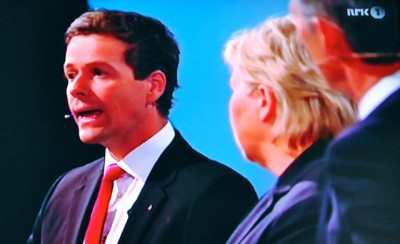
Leaders of small centrist parties like Knut Arild Hareide of the Christian Democrats are once again a wildcard in the current election campaign. Even though his party only holds less than 6 percent of the vote, it may be able to claim disproportionate power in how a new government is formed. PHOTO: newsinenglish.no/NRK screen grab
Leaders of small centrist parties like Knut Arild Hareide of the Christian Democrats are once again the wildcards in the current election campaign. Even though polls show his party holding less than 6 percent of the vote, it may be able to claim disproportionate power in how a new government is formed. Leaders of Norway’s biggest parties, Solberg and Stoltenberg, need to listen to him. PHOTO: newsinenglish.no/NRK screen grab
Knut Arild Hareide, leader of the center-oriented Christian Democrats (Kristelig Folkeparti, KrF), went so far as to say Monday night that he thinks a government made up of just Høyre and Frp would be “worse” than today’s left-center government. At the same time, he and other KrF officials are increasingly negative towards the idea of trying to govern with Frp. The differences between them, not least on immigration and welfare issues, are just too great.
Their counterparts at the Liberal party (Venstre) have been saying the same. Venstre leader Trine Skei Grande hammered through her party’s strong environmental policies at Monday night’s debate, not least their stand against oil drilling off Lofoten, and that’s totally at odds with Frp’s and Høyre’s positions. KrF and Venstre see themselves as the “green” element in an otherwise “blue” government, but none of the parties seems willing to campaign on a turquoise platform. KrF’s Hareide said it was the duty of the center parties to “put the brakes” on the more hard-line policies of the bigger parties, hinting that a coalition with just Høyre and Venstre may work.The small parties like his would still need a lot more votes than the polls indicate to have the “muscle” Frp leader Siv Jensen stressed is necessary to have power in a government coalition. Negotiations to form a non-socialist coalition platform, she herself warned, would be “very tough.”
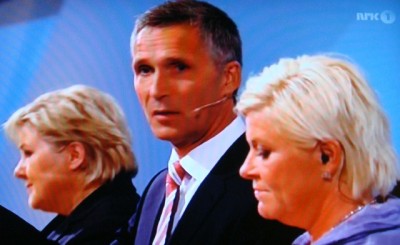
Prime Minister Jens Stoltenberg (center) is trying to hang onto government power, while Erna Solberg (left) and Siv Jensen (right) are trying to take it away from him. PHOTO: newsinenglish.no/NRK screen grab
It’s enough to make one wonder whether Solberg of Høyre now has any real chance at all of finding enough common ground among the four non-socialist (borgerlig)parties — Høyre, Frp, Venstre and KrF  – to form a government. Not only are doubts rising, some former Venstre ministers told newspaperDagsavisen on Tuesday that chances for a four-party coalition are now minimal. The other options would be a Høyre coalition with just Frp, a coalition with just Venstre and KrF, or Høyre going it alone, depending on much clout the voters give the individual parties.
Current Prime Minister Jens Stoltenberg seized on that doubt at the debate, challenging Solberg to clarify what voters could really expect from any non-socialist coalition. “We have shown that we can govern,” Stoltenberg claimed, even though he and his partners in the current “red-green” government are also campaigning separately during this election run-up and trailing in the polls. He criticized his “blue-green” rivals’ lack of a common program like Stoltenberg’s “red-green” pact had during the campaigns in 2005 and 2009, suggesting that voters don’t know what they’ll get if they vote for any of the non-socialist parties.
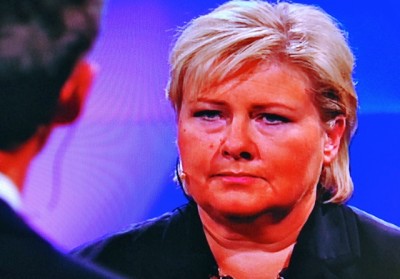
Conservatives' leader Erna Solberg was directly challenged over her support for removal of Norway's fortune tax, which researchers claim won't yield the results she believes it will. Stoltenberg also challenged Solberg to more clearly define how a government led by her would lead. Solberg appeared uncomfortable but unwavering in her stance. PHOTO: newsinenglish.no/NRK screen grab
Conservatives’ leader Erna Solberg was directly challenged over her support for removal of Norway’s fortune tax, which researchers claim won’t yield the results she believes it will. Stoltenberg also challenged Solberg to more clearly define how a government led by her would lead. Solberg appeared irritated and unwavering in her stance. PHOTO: newsinenglish.no/NRK screen grab
Only a few actual issues were addressed during Monday night’s live debate, including Norway’s controversial annual tax (formueskatt) on net worth (the socialists want to retain it, the non-socialists want to either phase it out or modify it) and the so-called handlingsregel, the rule that limits how much of the country’s oil revenues the government should spend. Prime Minister Jens Stoltenberg’s left-center, Labour-led government has been restrictive, limiting spending to just 4 percent of the size of Norway’s sovereign wealth fund. Solberg of the Conservatives seems inclined to spend more of Norway’s oil revenues “to make our society better, reduce waiting lists for health care, and make schools better.” Her potential government partner, Frp leader Siv Jensen, wants to spend even more, preferring to call it “investing” in projects at home in Norway instead of in the country’s oil fund. The smaller center parties predictably opt for a combination of the two, urging more flexibility in oil revenue use as needed but mostly hanging on to the oil fund’s purse strings.
There are, at least, some key differences between the left-center and right-center alternatives, with NRK’s program leaders joking that Solberg arrived in Arendal in a helicopter while Stoltenberg arrived in a taxi, referring to his taxi campaign stunt late last week. That didn’t stop Frp’s Jensen from accusing the Conservatives of becoming too much like Labour, though, in Tuesday’s Dagens Næringsliv (DN).
It is, perhaps, the ultimate irony that the left-leaning socialists want to restrict government spending in Norway, while the right-leaning non-socialists want to boost spending. That, at any rate, is what help makes Norway an annerledesland, literally a place where things are simply different than elsewhere in the world.

Monday, 12 August 2013

Ethiopian Development Destroying Lives

by GRAHAM PEEBLES

August 12, 2013 (Counter Punch) — In many parts of the world development has become an invisible cloak under which all manner of “state sponsored” atrocities and human rights violations are being committed. Married to growth, development has been (largely) reduced to economic advancement – meaning maximizing Gross National Product (GNP) figures month on month, year on year, and turning over glowing returns to the insatiable global monetary bodies – The World Bank and International Monetary Fund (IMF) and – profit to private investors.

A term overflowing with contradictions, development is often employed to dignify corporate activities, which are commonly no more than exploitation and profiteering, as in the case of the worldwide appropriation of land, usually to irresponsible, profit-driven foreign corporations and private hedge funds and equity fund managers, who boast of returns between 20% to 40% on investments. Huge pay offs which Anuradha Mittal of the Oakland Institute says is luring in “endowments including university endowments such as Harvard University, Vanderbilt University” and others. Such institutions Friends of the Earth, state “are stimulating land grabbing, which is destroying thousands of communities worldwide. “The financial sector”, they demand, “must take responsibility for their activities and ensure their investments respect human rights and abide by local environmental regulations”.

A broader more substantive definition of development would include the fulfillment of innate potential, the continuation of traditional lifestyles and the integrated development of individuals. Ideas that go beyond crass GNP or GDP measurements, globalisation statistics and Power Point clichés, which sees everything as a commodity and everyone as a consumer.

The homogenisation of life, a consequence of globalization, and the market economy (with its inherent inequality and lack of social justice), denies individuality, squashes or appropriates culture and imposes competition in all areas. A recipe for injustice and division fuelling anger and frustration, which for long suppressed, have surfaced in the popular uprisings of the Arab Spring and protest movements seen recently throughout the world.

The Lower Omo Valley

Over 70 different tribal groups contribute to the rich cultural tapestry that makes up Ethiopia. The beautiful Lower Omo Valley, in the south east of the country is home to a group of eight ancient tribes, indigenous people who have lived upon the land, for thousands of years, leading self-sufficient, simple lives in harmony with the environment. They live east and west along the 760 km long Omo River (the heartbeat of their lives), which flows from Ethiopia into Kenya, where it comes to rest in Lake Turkana.

In order to develop the rich and fertile land of the region, and honour leasehold agreement with foreign companies, the government is evicting indigenous people from their homes and driving them into settlement camps where, “the government promises us paradise, but we know that we are going to hell,” says one of the aggrieved Bodis, “Between tribes we have always found a solution, when a land conflict has arisen, but with the government it’s impossible”, the Oakland Institute (OI) report in Omo Local Tribes Under Threat.
Their homes destroyed and their land stolen from them, local people (including children and women) tell of horrendous government abuse.

These ancient people are, (they themselves say) being subjected to a range of atrocities constituting state criminality: the list of atrocities, shocking and vile, is made no less disturbing by its familiarity: arbitrary killings, rape, false imprisonment and torture are the methodology of the Ethiopian People’s Revolutionary Democratic Front (EPRDF) in the region as they clear people off land that is rightfully theirs, and either forcibly relocate them into state constructed villages, drive them into the forests to perish, or simply kill them in cold blood.

Land rights are complex, and whilst the Ethiopian constitution (written by the ruling regime but used at its convenience), states that all land ultimately belongs to the state, indigenous people are protected by a range of international treatise, to which Ethiopia is a signatory and binding articles within their own constitution. In addition, the government has said that the only land appropriate to be leased is land described as ‘marginal’, ‘unused’ or ‘wasteland’. Land regarded by the government as marginal is seen as central to the lives of indigenous people.


“Because the land is traditionally owned, under international law the traditional owners have the right to it as property. Changes to its use or seizure are illegal without the consultation and compensation of the lands’ traditional owners”, Human Rights Watch (HRW) make clear in their report ‘What Will happen If Hunger Comes”. As well as protecting indigenous people the constitution also safeguards agro-pastoralists (which the majority of affected tribal groups are made up of); section 40 (5); “Ethiopian pastoralists have the right to free land for grazing and cultivation as well as the right not to be displaced from their own lands”. Driving local people off their ancestral land which supplies their food and medicine, also breaches the International Covenant on Civil and Political Rights (ICCPR), which states, “in no case may a people be deprived of its own means of subsistence”. Add to this the violation of the Right to Culture and Religion and the Right to Health and a substantive legal shield forms to protect the tribal people in the Omo Valley, from government development plans. That is, providing such legal obligations are observed and enforced.


Gibe III Dam and Associated Land Development


Remote and culturally diverse, with prized United Nations Educational Scientific and Cultural Organization (UNESCO) World Heritage status, the Lower Omo valley is home to over 200,000 indigenous tribal people, including the Kwegu, Bodi, Mutsi, Suri and Nyangatom tribes. Their ancient ways of life and the delicate ecosystem, is being threatened, HRW report, “by the construction of a massive hydroelectric dam, known as Gibe III, on the Omo River and associated plans for large scale irrigated agriculture”. The massive Gilgel Gibe III dam was started in 2006, and we are told, is now 62% complete. Funding for the $2 billion project has come from a range of sources, including the Industrial and Commercial Bank of China (ICBC). The Europeans looked at the project and, concerned by the lack of impact assessment studies, culturally appropriate project consultations (required under the constitution), and under heated pressure from NGOs, wisely decided not to get involved, as did the World Bank.


International and regional aid organisations, Survival International (SI) among them, believe “the Gibe III Dam will have catastrophic consequences for the tribes of the Omo River, who already live close to the margins of life in this dry and challenging area”. Gibe III, no doubt much to the delight and misplaced pride of the government, will be the largest dam of its kind in Africa (243 meters tall), causing potentially some of the worst environmental and human carnage, by seriously impacting the lives of tribal groups of the Lower Omo area, as well as the 300,000 people who live around Lake Turkana in Kenya, which receives the majority of its water from the Omo River.


Water from the dam, which will double Ethiopia’s energy capacity, will be stored in a giant reservoir which will feed the plantations (445,000ha has so far been earmarked by the government) via hundreds of kilometers of pipelines. “Up to 200 kilometers (125 miles)” of such primary irrigation canals have already been built, along with an “earthen dam” to water the plantations which, OI tell us, “has stopped the annual flood that all people along the river depend on for agriculture, and in the process inundated cultivation sites of the Bodi and Kwegu people upstream.” In addition, SI makes clear; the combined effects of the projects “will result in the drying out of much of the riverine zone and will eliminate the Riparian Forest. Indigenous people such as the Kwegu who rely almost exclusively on fishing and hunting will be destitute”. One could be forgiven for thinking that this government is working to intentionally decimate native peoples’ lives and shatter the delicate ecology of the region.


The construction of the Gibe III dam and the interconnected development project of leasing ancestral land for agriculture (including bio-fuels), are being pursued by the government in a manner that is violating a range of human rights, as well as internationally binding legal agreements. Both schemes have been widely condemned by human rights groups and concerned NGOs, even USAID, Ethiopia’s largest single donor have berated the regime over their mistreatment of indigenous people.


Ideologically driven by narrow, distorted ideas of development and obsessed with economic growth, the EPRDF is pursuing a land sale policy that is causing enormous suffering to the lives of hundreds of thousands of indigenous people throughout the country. With the Lower Omo Valley projects there is a real risk “that the livelihoods of 500,000 people may be endangered, tens of thousands will be forcibly displaced, and that the region will witness increased inter-ethnic conflict as communities compete for scarce resources” HRW tell us.

Over 375,000 ha of fertile land in the Lower Omo valley, the Oakland Institute (OI) report in ‘Ignoring Abuse in Ethiopia’, is being turned over for “industrial scale plantations for sugar and other monocrops“ – the controversial, albeit high yield agricultural practice, of growing a single crop, year after year on the same land. Such methods damage the soil ecology, creating dependency on pesticides and fertilisers (all good for the agro-chemical giants) and use lots of water. Driven solely by profit, investors are only interested in high-quality, well irrigated water with good water supplies: they care little about the environmental impact on eco-systems and the devastation being caused to indigenous people and rural livelihoods, nor would it seem do the ruling EPRDF.


HRW estimate “around 100,000 ha is being made available to private ‘investors”, corporations from Malaysia, India, Italy and Korea who are planting biofuels and cash crops, e.g. cotton and maize. Together with state-owned sugarcane and cotton plantations run by the Ethiopian Sugar Corporation – an umbrella organisation of the central government, (which has taken 150,000 ha of tribal land for itself) and whose operations OI state, “will [negatively] impact the people of the Lower Omo most, especially the 170,000 along the river”.


Violent Evictions Killing and Rape


Mass displacements are accompanying these projects, OI report “260,000 local people from 17 ethnic groups in the Lower Omo and around Lake Turkana [in Kenya]—whose waters will be taken for plantation irrigation—are being evicted from their farmland and restricted from using the natural resources they have been relying on for their livelihoods”. The military are the violent enforcers of much of the regimes unlawful policies up and down the country, and so it is in the Omo valley: HRW record that “on the east bank of the Omo River, where farms are being cleared, grazing lands have been lost, and livelihoods are being destroyed. According to government maps and local sources this is just the beginning of a major transformation of the Lower Omo area”, [where] more than 2,000 soldiers are said to have been drafted into the area downstream of the dam and “most of the Omo valley is now off limits to foreigners”, The Guardian (7/02/2013) report. Including the international media and NGOs, “virtually no nongovernmental organisations (NGOs) work in the area, and members of indigenous communities have been warned not to speak to outsiders, especially foreigners“. Government gagging practices consistent with their approach elsewhere, the Ogaden and Gambella regions, as well as Oromia, where state terrorism is widespread, come readily to mind.

This re-settlement of indigenous people to allow for the commercialization of their land is taking place without the “free, prior and informed” consent (legally) required for any development project, with no compensation for loss of land and livelihood and without consultation, required within the constitution.
Indeed far from consulting with local people and allowing them the right to speak out freely (another constitutional fantasy), military units regularly visit villages, HRW record, to “suppress dissent related to the sugar plantation development [and associated re-settlement plans]. According to local people anything less than fully expressed support for sugar development was met with beatings, harassment, or arrest”. According to The Guardian killings and repression are now common, and go on to recount the story of a villager who says he “was shot with a bullet in my knee [when walking on his land]. That day 11 people were killed and the soldiers threw four bodies off Dima Village Bridge. They were eaten by hyenas”. Rape is a military weapon of choice being employed to frighten and intimidate, OI relay the particularly distressing account of “the gang rape of a young herd boy. They took a small boy that was herding cattle. They had sex with him for a long time in the forest. He was screaming. The boy couldn’t walk afterward. He had to be picked up and carried”.


Frustrated and angry and seeing no alternative, members of the Suri tribe on the west bank of the Omo river have taken up arms against the military. The government has decimated their land, clearing trees and grass to “allow Malaysian investors to establish plantations, water has also been diverted from the mainstay Koka River to these plantations leaving the largely pastoral Suri without water for their cattle”, according to the Oakland Institute. Government forces are maintaining a brutal campaign aimed at the Suri people. Friends of Lake Turkana, a Kenyan NGO reported in May 2012 that, “government forces killed 54 unarmed Suri in the market place at Maji in retaliation [to Suri actions against the military]. It is estimated that between 57 and 65 people died in the massacre and from injuries sustained on that day. Five more Suri have been killed since then… [and] Suri people are being arrested randomly and sentenced to 18, 20, and 25 years in prison for obscure crimes”.

Not only is the government destroying the lives of these tribal groups, they are also creating food insecurity and dependence on humanitarian food aid. Barred from “cultivating their own fields and [with the military] destroying crops and grain stores to cause hunger. People are then lured to the [resettlement] sites with food aid from international agencies”.


In 2011 former Prime-Minister Meles Zenawi, asserted that the industrial farms would “benefit the people of this area and hundreds of thousands of other Ethiopians, by creating employment”. Hollow political rhetoric – in fact, the government’s development plans for this region are destroying lives and livelihoods for the pastoralist indigenous people, whose only choice OI make clear “will be work on plantations for a low wage”. Zenawi cited the example of sugarcane plantations established in the Awash valley, but failed to say that tribal groups in the region lost their homes and their way of life and are now dependent on food aid to feed their families – the same is now happening in the Lower Omo valley.


In addition to losing their land, their homes and livelihoods, with the arrival of foreign workers, plus 2,000 soldiers in this previously quiet, hidden corner of Ethiopia, the people of the Lower Omo Valley have become exposed to a spate of health concerns. Prostitution is flourishing and due to men’s arrogant refusal to wear condoms, HIV/Aids is now prevalent amongst tribal members and “numerous cases of Hepatitis B, a disease transferred through blood and sex” has, OI state been reported in the area. Food insecurity, violent evictions (including killings and rape), cultural carnage, environmental destruction prostitution and HIV/Aids: all brought to the beautiful Lower Omo Valley by the government, and all in the name of development.

Saturday, 10 August 2013

Democratic Rights

source :  Abi Amare

Article 29

Right of Thought, Opinion and Expression

1.  Everyone has the right to hold opinions without interference.

2.  Everyone has the right to freedom of expression without any interference. This right shall include freedom to seek, receive and impart information and ideas of all kinds, regardless of frontiers, either orally, in writing or in print, in the form of art, or through any media of his choice.

3.  Freedom of the press and other mass media and freedom of artistic creativity is guaranteed. Freedom of the press shall specifically include the following elements:

a)  Prohibition of any form of censorship.

b)  Access to information of public interest.

4. In the interest of the free flow of information, ideas and opinions which are essential to the functioning of a democratic order, the press shall, as an institution, enjoy legal protection to ensure its operational independence and its capacity to entertain diverse opinions.

5.  Any media financed by or under the control of the State shall be operated in a manner ensuring its capacity to entertain diversity in the expression of opinion.

6.  These rights can be limited only through laws which are guided by the principle that freedom of expression and information cannot be limited on account of the content or effect of the point of view expressed. Legal limitations can be laid down in order to protect the well-being of the youth, and the honour and reputation of individuals. Any propaganda for war as well as the public expression of opinion intended to injure human dignity shall be prohibited by law.

7.  Any citizen who violates any legal limitations on the exercise of these rights may be held liable under the law.


Article 30

The Right of Assembly, Demonstration and Petition

1. Everyone has the right to assemble and to demonstrate together with others peaceably and unarmed, and to petition. Appropriate regulations may be made in the interest of public convenience relating to the location of open-air meetings and the route of movement of demonstrators or, for the protection of democratic rights, public morality and peace during such a meeting or demonstration.

2. This right does not exempt from liability under laws enacted to protect the well-being of the youth or the honour and reputation of individuals, and laws prohibiting any propaganda for war and any public expression of opinions intended to injure human dignity.


Article 31

Freedom of Association

Every person has the right to freedom of association for any cause or purpose. Organizations formed, in violation of appropriate laws, or to illegally subvert the constitutional order, or which promote such activities are prohibited.


Article 32

Freedom of Movement

1. Any Ethiopian or foreign national lawfully in Ethiopia has, within the national territory, the right to liberty of movement and freedom to choose his residence, as well as the freedom to leave the country at any time he wishes to.

2. Any Ethiopian national has the right to return to his country.


Article 33

Rights of Nationality

1. No Ethiopian national shall be deprived of his or her Ethiopian nationality against his or her will. Marriage of an Ethiopian national of either sex to a foreign national shall not annul his or her Ethiopian nationality.

2. Every Ethiopian national has the right to the enjoyment of all rights, protection and benefits derived from Ethiopian nationality as prescribed by law.

3. Any national has the right to change his Ethiopian nationality.

4. Ethiopian nationality may be conferred upon foreigners in accordance with law enacted and procedures established consistent with international agreements ratified by Ethiopia.


Article 34

Marital, Personal and Family Rights

1. Men and women, without any distinction as to race, nation, nationality or religion, who have attained marriageable age as defined by law, have the right to marry and found a family. They have equal rights while entering into, during marriage and at the time of divorce. Laws shall be enacted to ensure the protection of rights and interests of children at the time of divorce.

2. Marriage shall be entered into only with the free and full consent of the intending spouses.

3. The family is the natural and fundamental unit of society and is entitled to protection by society and the State.

4. In accordance with provisions to be specified by law, a law giving recognition to marriage concluded under systems of religious or customary laws may be enacted.

5. This Constitution shall not preclude the adjudication of disputes relating to personal and family laws in accordance with religious or customary laws, with the consent of the parties to the dispute. Particulars shall be determined by law.


Article 35

Rights of Women

1. Women shall , in the enjoyment of rights and protections provided for by this Constitution, have equal right with men.

2. Women have equal rights with men in marriage as prescribed by this Constitution.

3. The historical legacy of inequality and discrimination suffered by women in Ethiopia taken into account, women, in order to remedy this legacy, are entitled to affirmative measures. The purpose of such measures shall be to provide special attention to women so as to enable them to compete and participate on the basis of equality with men in political, social and economic life as well as in public and private institutions.

4. The State shall enforce the right of women to eliminate the influences of harmful customs. Laws, customs and practices that oppress or cause bodily or mental harm to women are prohibited.

(a) Women have the right to maternity leave with full pay. The duration of maternity leave shall be determined by law taking into account the nature of the work, the health of the mother and the well-being of the child and family.

(b) Maternity leave may, in accordance with the provisions of law, include prenatal leave with full pay.

5. Women have the right to full consultation in the formulation of national development policies, the designing and execution of projects, and particularly in the case of projects affecting the interests of women.

6. Women have the right to acquire, administer, control, use and transfer property. In particular, they have equal rights with men with respect to use, transfer, administration and control of land. They shall also enjoy equal treatment in the inheritance of property.

7. Women shall have a right to equality in employment, promotion, pay, and the transfer of pension entitlements.

8. To prevent harm arising from pregnancy and childbirth and in order to safeguard their health, women have the right of access to family planning education, information and capacity.


Article 36

Rights of Children

1. Every child has the right:

(a) To life;

(b) To a name and nationality;

(c) To know and be cared for by his or her parents or legal guardians;

(d) Not to be subject to exploitative practices, neither to be required nor permitted to perform work which may be hazardous or harmful to his or her education, health or well-being;

(e) To be free of corporal punishment or cruel and inhumane treatment in schools and other institutions responsible for the care of children.

2. In all actions concerning children undertaken by public and private welfare institutions, courts of law, administrative authorities or legislative bodies, the primary consideration shall be the best interest of the child.

3. Juvenile offenders admitted to corrective or rehabilitative institutions, and juveniles who become wards of the State or who are placed in public or private orphanages, shall be kept separately from adults.

4. Children born out of wedlock shall have the same rights as children born of wedlock.

5. The State shall accord special protection to orphans and shall encourage the establishment of institutions which ensure and promote their adoption and advance their welfare, and education.


Article 37

Right of Access to Justice

1. Everyone has the right to bring a justifiable matter to, and to obtain a decision or judgment by, a court of law or any other competent body with judicial power.

2. The decision or judgment referred to under sub-Article 1 of this Article may also be sought by:

a) Any association representing the Collective or individual interest of its members; or

b) Any group or person who is a member of, or represents a group with similar interests.


Article 38

The Right to Vote and to be Elected

1. Every Ethiopian national, without any discrimination based on colour, race, nation, nationality, sex, language, religion, political or other opinion or other status, has the following rights:

a) To take part in the conduct of public affairs, directly and through freely chosen representatives;

b) On the attainment of 18 years of age, to vote in accordance with law;

c) To vote and to be elected at periodic elections to any office at any level of government; elections shall be by universal and equal suffrage and shall be held by secret ballot, guaranteeing the free expression of the will of the electors.

2. The right of everyone to be a member of his own will in a political organization, labour union, trade organization, or employers’ or professional association shall be respected if he or she meets the special and general requirements stipulated by such organization.

3. Elections to positions of responsibility with any of the organizations referred to under sub-Article 2 of this Article shall be conducted in a free and democratic manner.

4. The provisions of sub-Articles 2 and 3 of this Article shall apply to civic organizations which significantly affect the public interest.


Article 39

Rights of Nations, Nationalities, and Peoples

1. Every Nation, Nationality and People in Ethiopia has an unconditional right to self-determination, including the right to secession.

2. Every Nation, Nationality and People in Ethiopia has the right to speak, to write and to develop its own language; to express, to develop and to promote its culture; and to preserve its history.

3. Every Nation, Nationality and People in Ethiopia has the right to a full measure of self-government which includes the right to establish institutions of government in the territory that it inhabits and to equitable representation in state and Federal governments.

4. The right to self-determination, including secession, of every Nation, Nationality and People shall come into effect:

a) When a demand for secession has been approved by a two-thirds majority of the members of the Legislative Council of the Nation, Nationality or People concerned;

b) When the Federal Government has organized a referendum which must take place within three years from the time it received the concerned council’s decision for secession;

c) When the demand for secession is supported by majority vote in the referendum;

d) When the Federal Government will have transferred its powers to the council of the Nation, Nationality or People who has voted to secede; and

e) When the division of assets is effected in a manner prescribed by law.

5. A "Nation, Nationality or People" for the purpose of this Constitution , is a group of people who have or share large measure of a common culture or similar customs, mutual intelligibility of language, belief in a common or related identities, a common psychological make-up, and who inhabit an identifiable, predominantly contiguous territory.


Article 40

The Right to Property

1. Every Ethiopian citizen has the right to the ownership of private property. Unless prescribed otherwise by law on account of public interest, this right shall include the right to acquire, to use and, in a manner compatible with the rights of other citizens, to dispose of such property by sale or bequest or to transfer it otherwise.

2. "Private property", for the purpose of this Article, shall mean any tangible or intangible product which has value and is produced by the labour, creativity, enterprise or capital of an individual citizen, associations which enjoy juridical personality under the law, or in appropriate circumstances, by communities specifically empowered by law to own property in common.

3. The right to ownership of rural and urban land, as well as of all natural resources, is exclusively vested in the State and in the peoples of Ethiopia. Land is a common property of the Nations, Nationalities and Peoples of Ethiopia and shall not be subject to sale or to other means of exchange.

4. Ethiopian peasants have right to obtain land without payment and the protection against eviction from their possession. The implementation of this provision shall be specified by law.

5. Ethiopian pastoralists have the right to free land for grazing and cultivation as well as the right not to be displaced from their own lands. The implementation shall be specified by law.

6. Without prejudice to the right of Ethiopian Nations, Nationalities, and Peoples to the ownership of land, government shall ensure the right of private investors to the use of land on the basis of payment arrangements established by law. Particulars shall be determined by law.

7. Every Ethiopian shall have the full right to the immovable property he builds and to the permanent improvements he brings about on the land by his labour or capital. This right shall include the right to alienate, to bequeath, and, where the right of use expires, to remove his property, transfer his title, or claim compensation for it. Particulars shall be determined by law.

8. Without prejudice to the right to private property, the government may expropriate private property for public purposes subject to payment in advance of compensation commensurate to the value of the property.


Article 41

Economic, Social and Cultural Rights

1. Every Ethiopian has the right to engage freely in economic activity and to pursue a livelihood of his choice anywhere within the national territory.

2. Every Ethiopian has the right to choose his or her means of livelihood, occupation and profession.

3. Every Ethiopian national has the right to equal access to publicly funded social services.

4. The State has the obligation to allocate an ever increasing resources to provide to the public health, education and other social services.

5. The State shall, within available means, allocate resources to provide rehabilitation and assistance to the physically and mentally disabled, the aged, and to children who are left without parents or guardian.

6. The State shall pursue policies which aim to expand job opportunities for the unemployed and the poor and shall accordingly undertake programmes and public works projects.

7. The State shall undertake all measures necessary to increase opportunities for citizens to find gainful employment.

8. Ethiopian farmers and pastoralists have the right to receive fair price for their products, that would lead to improvement in their conditions of life and to enable them to obtain an equitable share of the national wealth commensurate with their contribution. This objective shall guide the State in the formulation of economic, social and development policies.

9. The State has the responsibility to protect and preserve historical and cultural legacies, and to contribute to the promotion of the arts and sports.


Article 42

Rights of Labour


a) Factory and service workers, farmers, farm labourers, other rural workers and government employees whose work compatibility allows for it and who are below a certain level of responsibility, have the right to form associations to improve their conditions of employment and economic well-being. This right includes the right to form trade unions and other associations to bargain collectively with employers or other organizations that affect their interests.

b) Categories of persons referred to in paragraph (a) of this sub-Article has the right to express grievances, including the right to strike.

c) Government employees who enjoy the rights provided under paragraphs (a) and (b) of this sub-article shall be determined by law.

d) Women workers have the right to equal pay for equal work.

2. Workers have the right to reasonable limitation of working hours, to rest, to leisure, to periodic leaves with pay, to remuneration for public holidays as well as healthy and safe work environment.

3. Without prejudice to the rights recognized under sub - Article 1 of this Article, laws enacted for the implementation of such rights shall establish procedures for the formation of trade unions and for the regulation of the collective bargaining process.


Article 43

The Right to Development

1. The Peoples of Ethiopia as a whole, and each Nation, Nationality and People in Ethiopia in particular have the right to improved living standards and to sustainable development.

2. Nationals have the right to participate in national development and, in particular, to be consulted with respect to policies and projects affecting their community.

3. All international agreements and relations concluded, established or conducted by the State shall protect and ensure Ethiopia’s right to sustainable development.

4. The basic aim of development activities shall be to enhance the capacity of citizens for development and to meet their basic needs.


Article 44

Environmental Rights

1. All persons have the right to a clean and healthy environment.

2. All persons who have been displaced or whose livelihoods have been adversely affected as a result of State programmes have the right to commensurate monetary or alternative means of compensation, including relocation with adequate State assistance.